Posts

Showing posts with the label England

New England Ablaze: King Philips' War, 1675-1676

Image
King Philips' War, fought from 1675-1676 in the region known as New England in the Northeastern United States, predominately in the states of Massachusetts and Rhode Island, was one of the most devastating and bloody wars in America's early colonial history. Named for the powerful and greatly revered chief Metacomet (b.1676), the conflict precipitated the virtual extinction of New England's greatly varied and long established Native American tribes in favor of the rapidly growing American colonies of Plymouth, Massachusetts Bay, Connecticut, and the Rhode Island and Providence Plantations.  Two great figures dominate the military study of King Philips' War in New England, colonial officer and the "First American Ranger", Rhode Island born Captain Benjamin Church (b.1639-1718) of the Plymouth Colony, what is today  South   Shore  and  Cape Cod of  the state of  Massachusetts, and great  Wampanoag  sachem  (chief) Metacomet (d.1676) k...

Odd Fighting Units: Italian Frogmen and the Human Torpedoes of the Decima Flottiglia MAS, 1940-1943

Image
The Decima Flottiglia MAS (Decima Flottiglia Mezzi d'Assalto) known as La Decima or Xª MAS, the Italian 10th Assault Vehicle Flotilla was an elite naval unit active in World War from 1940-1945. This elite brigade of frogmen, sailors, and naval commandos most renowned service came between 1941-1943 when they undertook an ultimately failed but rather costly campaign against Allied military vessels and commerce shipping in the Mediterranean. Artist Depiction of Italian  Regia Marina  Frogmen, c.1941 When examining the impact that the Italian 10th MAS had during its years of service for Benito Mussolini’s (b.1883-1945) government from 1940-1943, one must understand the diverse composition of the brigade itself. Essentially four different branches comprised the unit during its fight against the British Royal Navy and Allied shipping, the Gamma frogmen, manned torpedo craft, midget submarines, and assault motorboat craft. Early Development of the Italian Assault Flotillas, 1917-1940...

War and Roses: Battles and Warfare in England's War of the Roses, 1461-1471

Image
Many of the campaigns and major battles which comprise the rich history of the War of the Roses were short in length, lasting only a few days as opposed to weeks or months. Warfare was undergoing a slow transformation throughout c.1440-1499 as the medieval age waned into the renaissance age. The lords, barons, dukes, and knights of this period brought rather small forces to bear in combat, around 200-2000 men. This were relatively diverse forces comprised mostly of archers and infantrymen, with diverse forces  cavalry artillery, and mercenaries from the continent. Towton, March 1461 Combat was almost always decisive in this era and battles were relatively short but hard fought and costly as a result. Even in small scale skirmishes the bloodshed was shocking by all accounts that survived the period from 1400 onwards. The Lords, Earls, Dukes, or Kings who served as generals and commander of their households were often in the thick of the battle near their vanguards; th...

Battle of Winchelsea 1350: The Great Anglo-Spanish Naval Battle of the Hundred Years’ Wars

Image
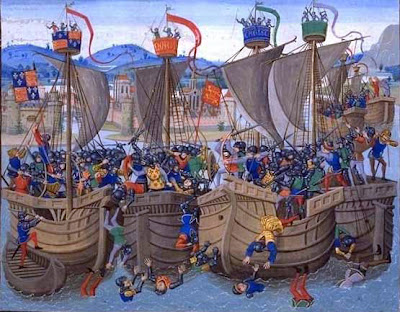
On August 29th of 1350, the Battle of Winchelsea, known also as the Battle of Les Espagnols Sur Mer , was fought off the southern coast England between the fleets of King Edward III of England (b.1312-1377) and the Castilian (Spanish) prince Don Carlos de la Cerda (b.1327-1354). The Channel was and is still today the gateway to south England and during the Hundred Years’ War (1337-1453) it was the site of the oft forgotten Battle of Winchelsea. The Battle of Sluys 1340 as depicted in an illumination from Froissart's Chronicles Battle of Winchelsea in 1450 An aggressive English naval strategy from 1340-1429 during the Hundred Years' Wars often led to the piracy of any and all ships crossing or returning from the Channel into the North Atlantic. A greater English strategy protected both the major channel ports and the western Irish sea ports, the English always wary of any French, Scottish, and/or Spanish vessels looking for easy plunder along the coast just as the Vikings of the...

The Northumberland Rebellions of 1405-1408 and the Battle of Bramham Moor 1408

Image
Henry Percy (b.1341-1408), the Earl of Northumberland did not remain quiet for long following the Battle of Shrewsbury and the death of his eldest son Sir Henry in 1403. He first had to answer for the crimes and treasons of his son which he denied involvement in and successfully distanced himself from despite strong supporting evidence that he knew and supported his late son’s rebellion. As a leading lord of the kingdom he must have been deeply troubled by the great upheavals caused by Welsh wars, the Scottish raids into his own lands, and the rebellion of his son now dead eldest son and heir which just been crushed by the king at  Shrewsbury  field. See Sir Hotspur's Uprising: The Battle of Shrewsbury, July 21, 1403 , for more. 18th century engraving of the elderly Earl of Northumberland As a father he must have grieved deeply, swearing atonement for his son and heir whose head now adorned the gate above the city of  York  as a lesson to would-be traitors and usurpe...