Posts

Showing posts with the label Warfare

Game Review: Warfare 1917

Image
Warfare 1917 , Con Artist Games, Chris “Con” Condon, Play for Free at Armor Games.Com Warfare 1917 is a free-to-play World War I game inspired by the brutal and seemingly wasteful loss of human life in the trenches and in no-man’s-land of Western Europe c.1917-1918. Behind this game’s gritty and simple exterior and basic controls is an addicting and challenging game play experience. This game is surprisingly historically accurate as well as fun and simple to play. For such a small game the creators and producers over at Con Artist Games did a wonderful job balancing each sides units. Warfare 1917 offers two standard campaign modes, the British or German Empire. A third mode allows the player to create a custom game keeping the replayability factor moderately high. In this mode the player can set their own parameters for the battle making themselves or their enemies as strong or as weak as they like. Tommies (British Infantry) in the trenches from Warfare 1917 In any mode the basic gam...

War and Roses: Battles and Warfare in England's War of the Roses, 1461-1471

Image
Many of the campaigns and major battles which comprise the rich history of the War of the Roses were short in length, lasting only a few days as opposed to weeks or months. Warfare was undergoing a slow transformation throughout c.1440-1499 as the medieval age waned into the renaissance age. The lords, barons, dukes, and knights of this period brought rather small forces to bear in combat, around 200-2000 men. This were relatively diverse forces comprised mostly of archers and infantrymen, with diverse forces  cavalry artillery, and mercenaries from the continent. Towton, March 1461 Combat was almost always decisive in this era and battles were relatively short but hard fought and costly as a result. Even in small scale skirmishes the bloodshed was shocking by all accounts that survived the period from 1400 onwards. The Lords, Earls, Dukes, or Kings who served as generals and commander of their households were often in the thick of the battle near their vanguards; th...

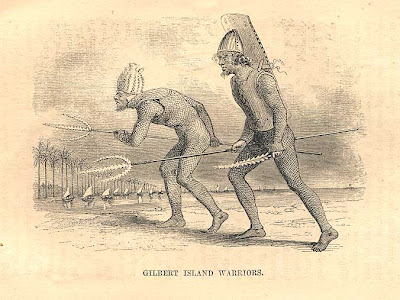
Odd Fighting Units: Kiribati Warrior of Micronesia

Image
Kiribati, known formerly as the the Gilbert Islands , the tiny stretch of islands and atolls in the expansive Pacific Ocean which make up the modern day Republic of Kiribati, was home to one of the most unique and curiously armored & armed infantry forces in the history of warfare.The Kiribati warrior culture of the Gilbertise Islanders developed both as a distinct part of the proud Polynesian warrior culture, which established itself from New Zealand to the Hawaiian Islands by the 14 th and 15 th centuries but from the unique materials with which the inhabitants of the Gilbert Islands armed themselves with. Early 20th century depiction of the Kiribati Warrior For the Kiribati warrior, his armor and weapons were the products of the readily available raw materials available from the islands and from the sea, combining the two for a unique armament approach. His armor was made of coir, a strong fiber material harvested from coconut trees, woven together it forms a durable and stro...

Great Anglo-Boer War, Part II, 1900-1902:Guerrillas in the Cape & the British response to the Bitter-Enders Insurgency

Image
Part I, Great Anglo-Boer War, 1899-1900 As Field Marshall Frederick Roberts looked for a decisive conclusion to hostilities between his armies and the Afrikaner Boer guerrillas, his chief-of-staff, Lord General  Kitchener was tasked with rounding up Boer pockets of resistance near the Cape Colonies in the former Transvaal and Orange Free State . He had come down with the flu shortly after his arrival in South Africa  and thus it would be  Kitchener basically who had complete control over most of the British forces in country as the next highest ranking general and as the chief-of-staff. He took to his task of defeating the Boer insurgency with quickly and with fervor, marching across the Modder River to engage Piet Cronje’s commando Held up in a laager on the banks of the Moddan River at the Paardeberg Drift. The old Boer was with his wife and 4,200 Boer guerrillas under arms. Cronje would be a major prize for the British army if he could be neutralized. The victor o...

War on the Scottish Border: The Battles of Otterburn & Homildon Hill, 1388-1402

Image
The violent life of the medieval knight and men-at-arms was defined by the societal structures of feudalism, crucial to the early periods of Anglo-Scottish conflict from the First Edwardian War (1296-1328) into the start of the 15th century when the English turned their attention to the kingdom of the Scots yet again. Especially true during King Edward I’s early reign when the major battles of the Scottish War of Independence were being decided in 1296-1314, ending with the Treaty of Northampton in the year 1328 which made Robert the Bruce (b.1274-1329), Robert I, King of Scots. [1] King Robert the Bruce, slays the English knight Sir Henry De Bohun at the Battle of Bannockburn in 1314 Shortly the signing of the treaty in a letter dated July 1328, King Robert sent a letter to Henry de Percy, second Baron of Alnwick [2] (b.1299-1351) affirming Baron de Percy and his heirs their rightful claim to the southern territories of the Scottish Kingdom. Of the several notable Scottish knights wh...