Posts

Showing posts with the label Great Britain

Odd Fighting Units: Kiribati Warrior of Micronesia
Image
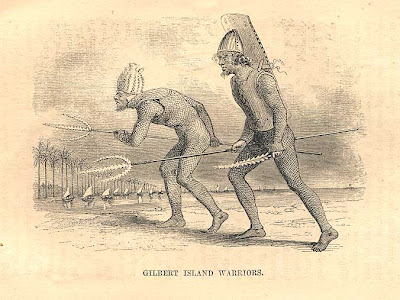
Kiribati, known formerly as the the Gilbert Islands , the tiny stretch of islands and atolls in the expansive Pacific Ocean which make up the modern day Republic of Kiribati, was home to one of the most unique and curiously armored & armed infantry forces in the history of warfare.The Kiribati warrior culture of the Gilbertise Islanders developed both as a distinct part of the proud Polynesian warrior culture, which established itself from New Zealand to the Hawaiian Islands by the 14 th and 15 th centuries but from the unique materials with which the inhabitants of the Gilbert Islands armed themselves with. Early 20th century depiction of the Kiribati Warrior For the Kiribati warrior, his armor and weapons were the products of the readily available raw materials available from the islands and from the sea, combining the two for a unique armament approach. His armor was made of coir, a strong fiber material harvested from coconut trees, woven together it forms a durable and stro...

Great Anglo-Boer War, 1899-1902, Part I: Triumph of the Boer and his Mauser Rifle 1895-1900

Image
Part II, Great Anglo-Boer War, 1900-1902 The Second Anglo-Boer War, or Second Boer War of 1899-1902, brought the British Empire into conflict yet again with the Afrikaner-Boers, the European pioneers of South Africa , who sought independence from England for their brother-nations, the Orange Free State and Transvaal republics. Led by an aging Queen Victoria, Sir Alfred Milner, High Commissioner for South Africa, and Joseph Chamberlain, Colonial Secretary, and a slew of regular army generals, the British land forces looked to establish commonwealth control over the Boer republics, utterly rich in diamond and gold mines, the colonial importance of South Africa was paramount to  the military and political spheres in London  throughout the years leading up to conflict, 1896-1899. Remembered today as one of the last major colonial conflicts of the 19 th century, the Great Anglo-Boer War , named so rather heroically by Sir Arthur Conan Doyle (b.1859-1930), left dead 22,000...

Greco-Italian War of 1940-1941

Image
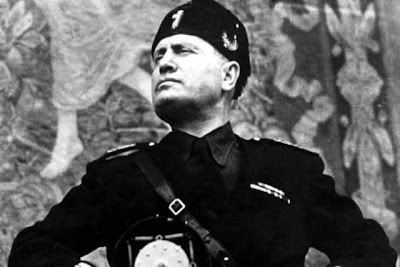
On this day in history 1940, during the early years of World War II, Il Duce Benito Mussolini’s (b.1883-1945) government declared war on Greece, starting the Italo-Greek War. This conflict would become the earliest front in the Greek campaign of the greater Mediterranean-North African campaign between by fascist Italy, Nazi Germany, and the Allies, principally Britain and her Commonwealth allies. Il Duce Benito Mussolini Using a massive invasion force of eight divisions, well over 200,000 men with full compliments of artillery, armor, and the warplanes of the Regia Aeronautica, which were launched from Albania , the Italians made an unexpected move towards war against the greater strategic aims of the Axis powers in October 1940. Most certainly Mussolini and his upper-echelon military generals realized that they must act alone in large scale military operation without the aid of Nazi Germany, so that their Axis allies and the enemies of Italy took them as a serious threat in the comin...

Prelude to the Wars of the Roses, Usurpation, Rebellion, and medieval warfare 1387-1403

Image
The multi-faceted causes of the War of the Roses are defined by two great medieval issues of note, compounded by the great upheavals of the century before it, notably England ’s arrival in France and the rise of the House of Lancaster following the usurpation of Richard II in 1399. The two major issues plaguing England which led to the Wars of the Roses were the rise of bastard feudalism, essentially a political and cultural problem greatly influenced by the martial culture of England from 1200 to 1455  [1] , and the dynastic rivalries and political machinations influenced and caused by the many battles fought between the houses and liege lords scattered throughout England from Northumberland to Cornwall. The Usurpation of 1399 and its preceding events and aftermath are in many ways the opening to the Wars of the Roses due in part to the upheavals initiated originally through popular dissent aimed at the economic/financial constraints of the period, which some peasants and lords al...

The Anglo-Asante Wars: ‘Hundred Years’ War’ for Africa's Gold Coast

Image
Of the many scattered imperial conflicts which comprise the martial history of Africa, most certainly the longest and drawn out conquests & military actions were the wars waged in the  Gold Coast, by the British Empire in what is now the Republic of Ghana in West Africa . Of the most powerful tribes and cultures, the Asante Empire (alternatively Ashanti or Ashantee) becomes arguably the most powerful military power in all of Africa’s history, perhaps only challenged by the Zulu of South Africa and maybe even the Mahdist warriors of Sudan, Egypt, and Ethiopia in the late 1890's. Starting in the early 1700’s with King Osei Tutu and continuing with his successor Opoku Ware, the Asante Empire with its capital at Kumasi , were unquestionably the strongest military presence in West Africa in the 1700’s and 1800’s. Eventually they would only be rivaled by a modern British Army who campaigned in 1873-1874. One major factor in the Asante ’s dominance over their Empire was ...