Posts

Showing posts with the label Soviet Union

Book Review: Redeye: Fulda Cold, A Novel By Bill Fortin

Image
Redeye: Fulda Cold, A Rick Fontain Novel. Written By Bill Fortin, 2013, (Cold War Publications, June, 2015). Available in print or as an eBook. Fortin's Redeye: Fulda Cold Redeye: Fulda Cold is author Bill Fortin’s military history novel detailing events during the Cold War 1969-1970. FIM-43 Redeye designed by General Dynamics from 1959-1967, lends its name and iconography to this exciting and personal military history fiction story filled with action-adventure, Cold War military intrigue/tactics & strategy, and the everyday high and lows of military life. As this novel depicts, the Cold War was not so stagnant for the men and women who served on both sides of the conflict during the 1960’s-1980’s. Throughout this story the reader follows Sgt. Rick Fontain, call sign Sparrow6, of the HHC 1st/48th Infantry Brigade stationed in West Germany as he leads the “Redeye” Fire Team at the Fulda Gap, the strategic bridge between East and West at the height of the Cold War the late 1960’s...

Polish-Soviet War 1919-1920: Part I, Poland's War in Latvia, Lithuania, & Western Ukraine

Image
Polish-Soviet War, 1919-1921 Part II Arguably one of the most important “Inter-War” conflicts of 1919-1938, the Polish-Soviet War of 1919-1920 was fought between a newly created and independent Polish Republic (1918-1939) and Bolshevik Russia in Poland, in the Baltic and Galicia and Western Ukraine primarily. Polish volunteer cavalry, a so-called 'Death Squadron', 1920 Born out of centuries of state warfare and great territorial and population shifts between long gone kingdoms, empires, and states of the medieval, renaissance, and enlightened eras (see the Partitions of Poland and the Border of 1772), the Polish-Soviet Wars’ origins lay most directly in the defeat of the Imperial German army in the West, November 1918. They had occupied Poland and Warsaw as a major fortified soldiercity on the Eastern Front against Imperial Russia from 1914-1917 during World War I. Polish independence was proclaimed immediately after the Armistice between the Entente and Central Powers and prov...

Battle of Khalkhin Gol: The Japanese-Soviet Border War of 1939

Image
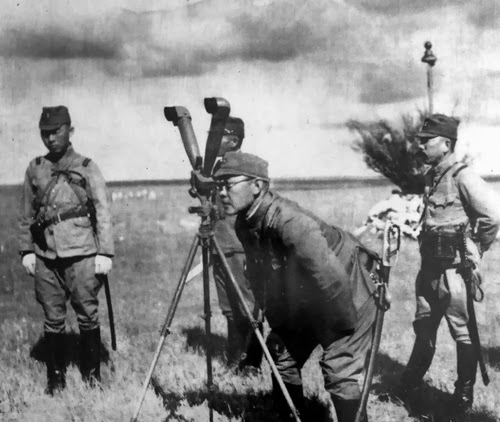
The Battle of Khalkhin Gol, known to the Japanese during the period as the Nomonhan Incident, is one of the most important conflicts of World War II that is often completely ignored or only a minor footnote in most concise or comprehensive popular history and academic studies of World War II. This border conflict fought on the edges between China and Mongolia developed into a major conflict during the Battle of Khalkhin Gol, dating back to previous border clashes during and after the Russian Civil War in the early 20's. The conflict quickly escalated in the spring of 1939 into a "small" conflict with a contained front that became a major theater of war by the time the Red Army claimed victory in September 1939-just as World War II had begun with the invasion of Poland. Japanese Officers observing the Nomonhan Front, 1939 Critical to the later events of World War II itself, Khalkhin Gol was one of the most decisive and important conflicts fought during the last months...

Nestor Makhno: Ukraine’s Anarchist Cossack and the Battle for the Ukraine, 1917-1921

Image
Of the many violent and often grandiose and dramatic revolutionist/reactionary heroes and/or tyrants of the Russian Civil War 1917-1921 perhaps none is as controversial or infamous as the Ukrainian anarchist-peasant turned revolutionary warlord, " Batko " (Father) Nestor Makhno (b.1889-1934). Nestor Makhno in 1919 The influence and the impact of the greater culture of the irregular guerrilla insurgent and cavalrymen cannot be overstated in regards to the Russian Civil War and its corresponding conflicts from 1917-1923. Though essentially outlaw bandits in some cases, there were some units who were legitimate military forces  as well, whether they be ‘Red’, ‘White’, revolutionary or reactionist, anarchist or nationalist, all were a product of Russian culture and the general socio-economic & cultural turmoil of the fall of the old Russian Imperial regime. Makhno and his anarchist Makhnovist faction were revolutionaries by doctrine and yet they were counter rev...