Posts

Showing posts with the label Africa

Great Anglo-Boer War, Part II, 1900-1902:Guerrillas in the Cape & the British response to the Bitter-Enders Insurgency

Image
Part I, Great Anglo-Boer War, 1899-1900 As Field Marshall Frederick Roberts looked for a decisive conclusion to hostilities between his armies and the Afrikaner Boer guerrillas, his chief-of-staff, Lord General  Kitchener was tasked with rounding up Boer pockets of resistance near the Cape Colonies in the former Transvaal and Orange Free State . He had come down with the flu shortly after his arrival in South Africa  and thus it would be  Kitchener basically who had complete control over most of the British forces in country as the next highest ranking general and as the chief-of-staff. He took to his task of defeating the Boer insurgency with quickly and with fervor, marching across the Modder River to engage Piet Cronje’s commando Held up in a laager on the banks of the Moddan River at the Paardeberg Drift. The old Boer was with his wife and 4,200 Boer guerrillas under arms. Cronje would be a major prize for the British army if he could be neutralized. The victor o...

The Anglo-Asante Wars: ‘Hundred Years’ War’ for Africa's Gold Coast

Image
Of the many scattered imperial conflicts which comprise the martial history of Africa, most certainly the longest and drawn out conquests & military actions were the wars waged in the  Gold Coast, by the British Empire in what is now the Republic of Ghana in West Africa . Of the most powerful tribes and cultures, the Asante Empire (alternatively Ashanti or Ashantee) becomes arguably the most powerful military power in all of Africa’s history, perhaps only challenged by the Zulu of South Africa and maybe even the Mahdist warriors of Sudan, Egypt, and Ethiopia in the late 1890's. Starting in the early 1700’s with King Osei Tutu and continuing with his successor Opoku Ware, the Asante Empire with its capital at Kumasi , were unquestionably the strongest military presence in West Africa in the 1700’s and 1800’s. Eventually they would only be rivaled by a modern British Army who campaigned in 1873-1874. One major factor in the Asante ’s dominance over their Empire was ...

Warfare and Diplomacy in the News, the War in Mali

Image
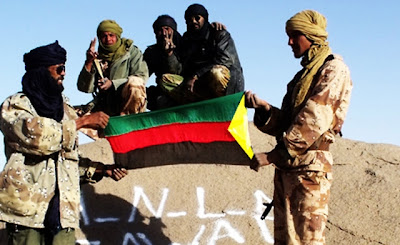
Mali is a Western African country in the heart of the Sahara desert. Granted independence in 1960 from France it is a leading cotton producer (amongst other raw materials) who has struggled through years of poverty, disease, famine, military dictators, and rebellions. Tuareg Rebels with the Azawad Flag A breakaway state, Azawad, proclaimed its independence from Mali on April 6, 2012 with its capital in Timbukutu. This was initiated in Northern Mali by the Tuaregs, nomad peoples of the Sahara from Libya, Algeria, and the surrounding nations, who had fought previously in Libya, and the National Movement for the Liberation of Azawad or MNLA. Even more recently however as of last week, the MNLA appear to have been routed by the Ansar Dine. An Islamist guerrilla movement once allied with the MNLA and the Tuaregs, Ansar Dine is believed by many Western sources to be an Al-Qaeda allied Islamist fundamentalist terrorist movement. As of JJuly 1st and 2nd 2012, the MNLA seem to be in retreat fo...

Liberian Civil Wars: Insurgency, terrorism, & revolution in Liberia: 1989-1996 & 1999-2003

Image
Of the many bloody conflicts to befall the various regions of Africa from 1945-2012, the Civil Wars of the continent have been particularly brutal beacuse of the overwhelming loss of human life, mostly non-combatants caught in the crossfire of modern weaponry and geo-political fervor, which often spills into other nations and regions following social and politcal conflict The Liberian Civil Wars, first from 1989-1996, and then from 1999-2003, are an example of the chaos and bloodshed that can arise from Civil War and internal strife in the developing regions of the World. Recently the events in Liberia which were so brutal and horrible have come into the news feed once again following their former president Charles Taylor's conviction of War crimes  for his role in Sierra Leone's Civil War from 1991-2000. The international tribunal who convicted Taylor was significant because it was the first time since World War II that a head of state has been put on tria...

Brief History of Italian Imperialism, Part III: Turkish (Libyan) War 1911-1912, the Great War, and the Italo-Abyssinian War, 1935-1936

Image
Following their defeat in Ethiopia expansionist & imperialist sentiment was very quiet while Italy recovered in the wake of unrest that rocked most of the free world in the late 1890's and 1900's. Italy would play a major role nevertheless in the inter-state conflicts that preceded the Great War in North Africa, the Mediterranean, and the Balkans, leading inevitably into buildup of nationalist sentiments that stoked the fires of a great conflict in 1914-1915. Captain Piazza’s Blériot XI during the campaign in Libya 1911 The Italian desire for expansion in North Africa, a more natural region geographically speaking to conquer, or acquire diplomatically than Ethiopia would have been, led the Italians to seek war with Turkey ( and the Ottoman Empire) over control of Libya, known then by the regional states of Tripolitania, Fezzan, & Cyrenaica. The Italians used gunboat diplomacy  successfully  where the German Empire had failed in the Moroccan crisis w...

Brief History of Italian Imperialism, Part II: Battle of Dogali 1887, the Mahdist Revolt, and the Battle Of Adowa 1896

Image
Following the annexations of coastal territories by the Italians which cut off the growing Ethiopian Empire from the sea to East, Emperor Yohannes IV and one of his most trusted lords, Ras Alula raised armies to combat further Italian incursion, which by early 1887 had slowly begun to move inland. The most significant clash of this early period came at the Battle of Dogali on January 26 1887. Ras Alula Engida, a respected and influential military commander and Ethiopian lord around 1890 Ras Alula and around 10,000 of his men attacked a column of 500 Italian regulars who had set out to relieve forces attacked the previous at Fort Saati. Despite inflicting heavy casualties on the attacking Ethiopians the Italians were routed, loosing 23 officers and 407 enlisted men in the process.  Like most victories over Imperial powers the Ethiopians could only enjoy their success for a time and by the end of year 18,000 Italian troops were in Eritrea. By 1888 these force...

A Brief History of Italian Imperialism: Part I, Garibaldi's new Italy

Image
The following three part series seeks to trace the military and diplomatic origins & course of Italian Imperialism in the mid to late 19th century to the early 20th century, especially at it pertains to Ethiopia and Northeastern Africa.  Check out the Mad Monarchists blog post on the Italian Colonial Empire http://italianmonarchist.blogspot.com/2012/03/italian-colonial-empire.html Of the several great Imperial powers worth studying in the 19th and early 20th centuries, Italy always seems to fall short of the standards of conquest, through military and/or diplomatic means, that defined the course of history for Europe but more importantly the developing nations and republics which formed after the retreat of imperialism and colonialism in Africa especially. Like in Germany or even America in the mid to late 19th century, Italy's national identity was fragmented due regional attitudes which eschewed the very idea of a centralized empire controlling all of the natio...