Posts

Showing posts with the label United Kingdom

War and Roses: Battles and Warfare in England's War of the Roses, 1461-1471

Image
Many of the campaigns and major battles which comprise the rich history of the War of the Roses were short in length, lasting only a few days as opposed to weeks or months. Warfare was undergoing a slow transformation throughout c.1440-1499 as the medieval age waned into the renaissance age. The lords, barons, dukes, and knights of this period brought rather small forces to bear in combat, around 200-2000 men. This were relatively diverse forces comprised mostly of archers and infantrymen, with diverse forces  cavalry artillery, and mercenaries from the continent. Towton, March 1461 Combat was almost always decisive in this era and battles were relatively short but hard fought and costly as a result. Even in small scale skirmishes the bloodshed was shocking by all accounts that survived the period from 1400 onwards. The Lords, Earls, Dukes, or Kings who served as generals and commander of their households were often in the thick of the battle near their vanguards; th...
Little Scottish-Jacobite Rebellion: The First Jacobite Rebellion and the Battle of Glen Shiel 1719

Image
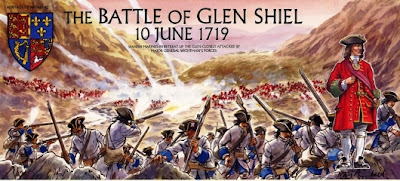
On this day in History in 1719, the Battle of Glen Shiel was fought in the Northwestern highlands of Scotland between Jacobite rebels and their Spanish allies in support of the Jacobite pretender to the thrones of England, Ireland, and Scotland, James Francis Edward Stuart (b.1688-1766) and the royal army of King George I, King of Great Britain and Ireland. The only major engagement of the 1719 Jacobite Uprising, the Battle of Glen Shiel is notable for the presence of Spanish interventionist forces as well. British stamp collection cover of the Spanish "Galicia" regiments' retreat at the Battle of Glen Shiel, June 10th 1719 One of the major Jacobite Uprisings next to the Jacobite War in Ireland 1689-1691 and the Rebellion of 1745-1746 (most notable for the Battles of Prestonpans in 1745 and Culloden Moor in 1746), led by Prince Charles Edward Stuart (b.1720-1788), ‘Bonnie Prince Charlie’, the Battle of Glen Shiel was an utter, and near catastrophic defeat for the Jacobite...

Battle of Lewes 1264 and the Rebellion of Baron Simon de Montfort

Image
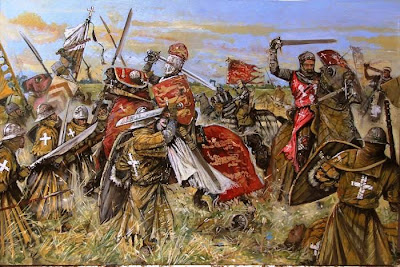
On this day in 1264, the Simon de Montfort the Earl of Leicester (b.1208-1265) won a stunning victory over the royal armies of King Henry III (b.1207-1272), led by his son Prince Edward (1239-1307). Known today as Edward Longshanks and   as King of England, Edward I (r.1272-1307), the Hammer of the Scot s, the Battle of Lewes was fought in Sussex, England and and was shattering victory of the royal army. Arguably the most well known battles to have been fought during the struggles of the Barons' Wars in 1215-1217 and in 1264-1267, de Montfort's victory at Lewes made him (disputably) a candidate to become the next sovereign King of England. Prince Edward, center, fights at the Battle of Lewes, Today in History, 1264 The Baron's Wars themselves are singularly important because of the creation of the Magna Carta 1215, and for de Montfort's later calls to create a strong representative parliament to check the then unlimited power of the King and the Engli...

Book Review: A Short History of the Wars of the Roses by David Grummit

Image
A Short History of the Wars of the Roses. By David Grummit. London: I.B. Tauris, 2013. Distributed in the U.S. and Canada by Palgrave Macmillan. ISBN 978-1-84885-875-6. Dramatis personae. Timeline. Family trees. Map. Illustrations. Notes. Bibliography. Index. Pp. xxxix, 212. $25.00. A Short History of the Wars of the Roses, by David Grummit In May 1455, the recently dismissed Protector of the Realm, Richard the Duke of York, met the royalist Lancastrian army of King Henry IV, “vi et armis”, with force and arms (p. 43), winning a decisive but bloody victory at the First Battle of St. Albans. The Yorkist victory over the Lancastrians that day on the streets of St. Albans beginning the sporadic and violent episodes of rebellion, upheaval, and open warfare which characterized the greater period of English medieval history from 1455-1487, known today as the Wars of the Roses. Yorkist line at the Battle of Towton Author David Grummitt’s primary goal in A Short History of the Wars of the Rose...

The Boxer Rebellion 1899-1901: Eight Nation Alliance and the Bloody Defeat of the Chinese Boxer 'Braves'

Image
The Boxer rebellion is a most fascinating conflict to study because of the unique nature of the conflict amongst many other notable conflicts fought at the very end of the 19 th century and into the early 1900's. Many histories written in modern times have highlighted the international diplomatic and military effort's of the Eight Nation Alliance which was arguably the first modern age military coalition force of its kind. Allied armies attack the Peking (Beijing) palace during the Boxer Rebellion 1900 Their enemy, the mystic Chinese ‘Boxer’ rebels (nationalists) of the Society of ‘Righteous Harmonious Fists’, fundamentalists patriots who were fighting to expel "Western" allied influence (Austria-Hungary, France, Germany, Italy, Russia, the United Kingdom, and the United States, and Japan) from China. A conflict marked by bloody insurrections, atrocities, and costly sieges, the Boxer Rebellion of 1899-1901 is a critical study in early-modern world diplomacy, war...

War on the Scottish Border: The Battles of Otterburn & Homildon Hill, 1388-1402

Image
The violent life of the medieval knight and men-at-arms was defined by the societal structures of feudalism, crucial to the early periods of Anglo-Scottish conflict from the First Edwardian War (1296-1328) into the start of the 15th century when the English turned their attention to the kingdom of the Scots yet again. Especially true during King Edward I’s early reign when the major battles of the Scottish War of Independence were being decided in 1296-1314, ending with the Treaty of Northampton in the year 1328 which made Robert the Bruce (b.1274-1329), Robert I, King of Scots. [1] King Robert the Bruce, slays the English knight Sir Henry De Bohun at the Battle of Bannockburn in 1314 Shortly the signing of the treaty in a letter dated July 1328, King Robert sent a letter to Henry de Percy, second Baron of Alnwick [2] (b.1299-1351) affirming Baron de Percy and his heirs their rightful claim to the southern territories of the Scottish Kingdom. Of the several notable Scottish knights wh...