Posts

Showing posts with the label medieval

War and Roses: Battles and Warfare in England's War of the Roses, 1461-1471

Image
Many of the campaigns and major battles which comprise the rich history of the War of the Roses were short in length, lasting only a few days as opposed to weeks or months. Warfare was undergoing a slow transformation throughout c.1440-1499 as the medieval age waned into the renaissance age. The lords, barons, dukes, and knights of this period brought rather small forces to bear in combat, around 200-2000 men. This were relatively diverse forces comprised mostly of archers and infantrymen, with diverse forces  cavalry artillery, and mercenaries from the continent. Towton, March 1461 Combat was almost always decisive in this era and battles were relatively short but hard fought and costly as a result. Even in small scale skirmishes the bloodshed was shocking by all accounts that survived the period from 1400 onwards. The Lords, Earls, Dukes, or Kings who served as generals and commander of their households were often in the thick of the battle near their vanguards; th...
Battle of Winchelsea 1350: The Great Anglo-Spanish Naval Battle of the Hundred Years’ Wars

Image
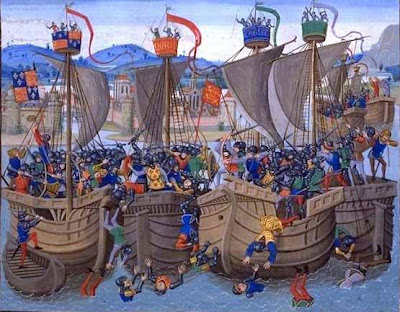
On August 29th of 1350, the Battle of Winchelsea, known also as the Battle of Les Espagnols Sur Mer , was fought off the southern coast England between the fleets of King Edward III of England (b.1312-1377) and the Castilian (Spanish) prince Don Carlos de la Cerda (b.1327-1354). The Channel was and is still today the gateway to south England and during the Hundred Years’ War (1337-1453) it was the site of the oft forgotten Battle of Winchelsea. The Battle of Sluys 1340 as depicted in an illumination from Froissart's Chronicles Battle of Winchelsea in 1450 An aggressive English naval strategy from 1340-1429 during the Hundred Years' Wars often led to the piracy of any and all ships crossing or returning from the Channel into the North Atlantic. A greater English strategy protected both the major channel ports and the western Irish sea ports, the English always wary of any French, Scottish, and/or Spanish vessels looking for easy plunder along the coast just as the Vikings of the...

The Northumberland Rebellions of 1405-1408 and the Battle of Bramham Moor 1408

Image
Henry Percy (b.1341-1408), the Earl of Northumberland did not remain quiet for long following the Battle of Shrewsbury and the death of his eldest son Sir Henry in 1403. He first had to answer for the crimes and treasons of his son which he denied involvement in and successfully distanced himself from despite strong supporting evidence that he knew and supported his late son’s rebellion. As a leading lord of the kingdom he must have been deeply troubled by the great upheavals caused by Welsh wars, the Scottish raids into his own lands, and the rebellion of his son now dead eldest son and heir which just been crushed by the king at  Shrewsbury  field. See Sir Hotspur's Uprising: The Battle of Shrewsbury, July 21, 1403 , for more. 18th century engraving of the elderly Earl of Northumberland As a father he must have grieved deeply, swearing atonement for his son and heir whose head now adorned the gate above the city of  York  as a lesson to would-be traitors and usurpe...

Battle of Lewes 1264 and the Rebellion of Baron Simon de Montfort

Image
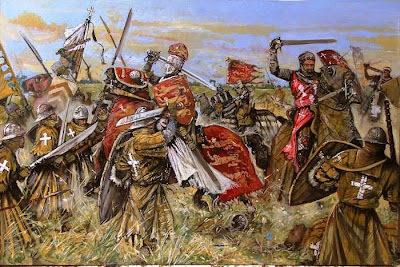
On this day in 1264, the Simon de Montfort the Earl of Leicester (b.1208-1265) won a stunning victory over the royal armies of King Henry III (b.1207-1272), led by his son Prince Edward (1239-1307). Known today as Edward Longshanks and   as King of England, Edward I (r.1272-1307), the Hammer of the Scot s, the Battle of Lewes was fought in Sussex, England and and was shattering victory of the royal army. Arguably the most well known battles to have been fought during the struggles of the Barons' Wars in 1215-1217 and in 1264-1267, de Montfort's victory at Lewes made him (disputably) a candidate to become the next sovereign King of England. Prince Edward, center, fights at the Battle of Lewes, Today in History, 1264 The Baron's Wars themselves are singularly important because of the creation of the Magna Carta 1215, and for de Montfort's later calls to create a strong representative parliament to check the then unlimited power of the King and the Engli...

Book Review: A Short History of the Wars of the Roses by David Grummit

Image
A Short History of the Wars of the Roses. By David Grummit. London: I.B. Tauris, 2013. Distributed in the U.S. and Canada by Palgrave Macmillan. ISBN 978-1-84885-875-6. Dramatis personae. Timeline. Family trees. Map. Illustrations. Notes. Bibliography. Index. Pp. xxxix, 212. $25.00. A Short History of the Wars of the Roses, by David Grummit In May 1455, the recently dismissed Protector of the Realm, Richard the Duke of York, met the royalist Lancastrian army of King Henry IV, “vi et armis”, with force and arms (p. 43), winning a decisive but bloody victory at the First Battle of St. Albans. The Yorkist victory over the Lancastrians that day on the streets of St. Albans beginning the sporadic and violent episodes of rebellion, upheaval, and open warfare which characterized the greater period of English medieval history from 1455-1487, known today as the Wars of the Roses. Yorkist line at the Battle of Towton Author David Grummitt’s primary goal in A Short History of the Wars of the Rose...

Sir Hotspur's Uprising: The Battle of Shrewsbury, July 21, 1403

Image
See the Battle between House Percy and Clan Douglas during the Anglo-Scots border conflict: Otterburn to Homildon Hill 1388-1402  for more. The motivations behind Sir Henry Percy, known to the Scots as 'Hotspur' (b.1364-1403), transformation from loyal knight in service to the realm regardless of whom was sitting on the throne in Westminster into a rebel and attainted traitor looking to kill his lawful king in battle, were complex. There is still some doubt historically as to exactly what Hotspur looked to accomplish in his rising. Certainly a catalyst for Hotspur's rebellion was a reaction to a society in both himself and his father were apart of. This hegemony and societal structure defined by the tenets of feudal service in the age of chivalry (coming to an end by the mid 1400's), amidst the violent life of the Anglo-Norman knight. Death of Hotspur on the field at Shrewsbury Both henry and his father the Earl of Northumberland expected titles, a moderately high salar...