Posts

Showing posts with the label This day in history

Little Scottish-Jacobite Rebellion: The First Jacobite Rebellion and the Battle of Glen Shiel 1719
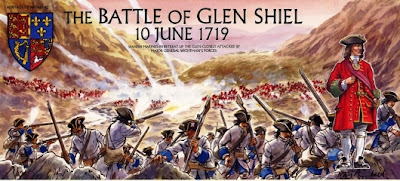
Image
On this day in History in 1719, the Battle of Glen Shiel was fought in the Northwestern highlands of Scotland between Jacobite rebels and their Spanish allies in support of the Jacobite pretender to the thrones of England, Ireland, and Scotland, James Francis Edward Stuart (b.1688-1766) and the royal army of King George I, King of Great Britain and Ireland. The only major engagement of the 1719 Jacobite Uprising, the Battle of Glen Shiel is notable for the presence of Spanish interventionist forces as well. British stamp collection cover of the Spanish "Galicia" regiments' retreat at the Battle of Glen Shiel, June 10th 1719 One of the major Jacobite Uprisings next to the Jacobite War in Ireland 1689-1691 and the Rebellion of 1745-1746 (most notable for the Battles of Prestonpans in 1745 and Culloden Moor in 1746), led by Prince Charles Edward Stuart (b.1720-1788), ‘Bonnie Prince Charlie’, the Battle of Glen Shiel was an utter, and near catastrophic defeat for the Jacobite...
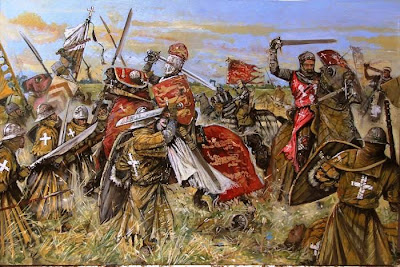
Battle of Lewes 1264 and the Rebellion of Baron Simon de Montfort

Image
On this day in 1264, the Simon de Montfort the Earl of Leicester (b.1208-1265) won a stunning victory over the royal armies of King Henry III (b.1207-1272), led by his son Prince Edward (1239-1307). Known today as Edward Longshanks and   as King of England, Edward I (r.1272-1307), the Hammer of the Scot s, the Battle of Lewes was fought in Sussex, England and and was shattering victory of the royal army. Arguably the most well known battles to have been fought during the struggles of the Barons' Wars in 1215-1217 and in 1264-1267, de Montfort's victory at Lewes made him (disputably) a candidate to become the next sovereign King of England. Prince Edward, center, fights at the Battle of Lewes, Today in History, 1264 The Baron's Wars themselves are singularly important because of the creation of the Magna Carta 1215, and for de Montfort's later calls to create a strong representative parliament to check the then unlimited power of the King and the Engli...

Battle of the Wells of Badr: Muhammad's Great Victory in 624

Image
On March 20th in the year 624, Islamic prophet and general Muhammad defeated his Meccan (Quraysh) enemies at the wells of Badr southwest of Medina  (in what is today Saudi Arabia), in one of the most important battles and decisive victories in the early history of Islam. As the Prophet Muhammad (b.570-d.632) gained followers he gained enemies as well, especially amongst the various tribes of Medina and the outer lying provinces around Mecca and later Medina . Charge of the Muslims at Badr by the Persian historian Rashid-al-Din (b.1247-1318) Both the sedentary and nomadic peoples of these regions feared Muhammad’s growing influence, these kuffār (or kafirs, Arabic for unbeliever or infidel) being the greatest threat to the growth of Islam as a major religion. Long persecuted by the Quraysh and the smaller associated tribes near Mecca , the growing Muslim population and its military apparatus, prepared for an inevitable clash with their neighbors after the Prophet and his followers...

King Henry V’s Victory at the Battle of Agincourt in 1415

Image
On this day in history 1415, an English army led by King Henry V, the Duke of Gloucester, and Edward the Duke of York, defeated a French army led by the Constable of France, Charles d'Albret at Agincourt (Azincourt). Known for being a crushing French defeat, the Battle of Agincourt ( in Pas-de-Calais, Northern France) is the single most well known event of King Henry's V short but war-racked reign. King Henry V's, pictured top right at Battle of Agincourt ,October, 1415 Ever seeming to be an enigmatic figure, historical accounts prove that King Henry was in all likelihood a religious zealot, not just a pious king of Christendom as would be expected but a man holding supreme self confidence in his abilities as a lord, knight, and conqueror. Still today Henry V’s greatest legacy relates to his military victories as most of his reign focused on conquering or raising and saving the coin necessary to conquer France . As prince, Henry of Monmouth had done everything that could be...

Battle of Bosworth Field 1485: The Death and Usurpation of King Richard III

Image
A whirlwind of events set the stage for the last great medieval battle in English history, the Battle of Bosworth Field of 22 August 1485. The sudden death of King Edward IV in April of 1483 thrust his young son Edward V (b.1470-Missing, 1483) into nominal rule until his forever historically maligned uncle, Richard the Duke of Gloucester (b.1452-1485) , seized the young king and his younger brother Richard the Duke of York Richard acted decisively; detaining their legal protectors and retinues, having most of them executed. Following the disinheritance and disappearance (and probable murder) of his two nephews, Gloucester survived his own betrayal in the rebellion of the Duke of Buckingham in October of that year to ascend to the throne on 26 June 1483 as King Richard III. His only son, the sickly eight year old Prince of Wales would predecease him in the year 1484.  Richard III charges at the Battle of Bosworth (Osprey) In the winter of the next year King Richard's beloved wi...

Battle of Lumphanan 1057: Macbethian era Scotland

Image
On this day in History 1057, Macbeth, the King of Scots, then known as the King of Alba, was killed at the Battle of [the Peelring of] Lumphanan in what is today Aberdeenshire , Scotland . Macbeth was killed in battle by the combined Scottish-Scandinavian army of Prince Malcolm Canmore, the son of the dethroned and murdered King Duncan I. Macbeth in combat, 19th century depiction The Battle of Lumphanan began when a small band of Macbeth’s retainers, 300-450 mounted warriors and the former King Macbeth were ambushed as they were on the march south by Prince Malcolm’s army near or at the Peelring of Lumphanan, southeast of Essie. An odd looking landmark, the Peel of Lumphanan is a sort of pudgy hill fortification or redoubt, which the saga writers and chroniclers believed was the likely place where the battle was fought and the usurper-king killed. Macbeth was either found amongst the dead on the battlefield by Prince Malcolm or captured and summarily executed immediately after th...