Posts

Showing posts with the label Imperial Japanese Army

Odd Fighting Units: The Manchurian Stormtroopers, Japan's Skull Squadron, 1929-1933

Image
The Second Sino-Japanese Conflict of 1931-1945 saw thousands of different regiments, divisions, units, and armies, nationalities fighting throughout what is today Mainland China, Myanmar (Burma), Mongolia, and Korea. Torn apart by revolution and civil war from 1911-1930, China faced a great challenge to its national sovereignty when the mighty Japanese military decided to press its economic and political claims in Manchuria and Northern China beginning in 1930-1931. Japanese Army artillery in Manchuria, 1931 One of the most unique Imperial Japanese Army (IJA) units to fight in the earliest portion of the great Sino-Japanese conflict of 1931-1945 was the Skull Regiment, known alternatively as the Skull Squadron and as the “Manchurian Stormtroopers” for their unique regimental iconography and symbols. The Japanese Skull Regiment was seemingly inspired by the German Totenkopf, or Death’s Head regiments/brigades of the 18th-20th centuries.  Formed originally during the reign of King Fr...

Imperial Japan's Kwantung Army: China, Manchuria, & Mongolia, 1931-1937

Image
The culture of the Japanese Army and its rigid command structure is critical in analyzing the strategies used by them in China from 1931-1939. The Kwantung Army was an anomaly in the greater study of the Imperial Japanese Army (IJA) from 1900-1945, in that it often took extra-judicial measures in its occupied territories and theatres of operations. Formed in 1919 from the original  Kwantung Garrison , which since 1906 had guarded the southern Manchurian railway from bandits or enemy nations, the Kwantung garrisoned the Liaodong Peninsula. Occupation of this territory had begun during the First Sino-Japanese War of 1894-1895. Japanese Army 'Skull Squadron' Manchuria, 1933 Soon dominated by young officers who privatized and isolated command, the Kwantung often operated under regional command structures. This so called "loyal insubordination" became the key to the Kwantung's military doctrine whilst serving in Manchuria and Northern China beginning in the early 1920...

Battle of Khalkhin Gol: The Japanese-Soviet Border War of 1939

Image
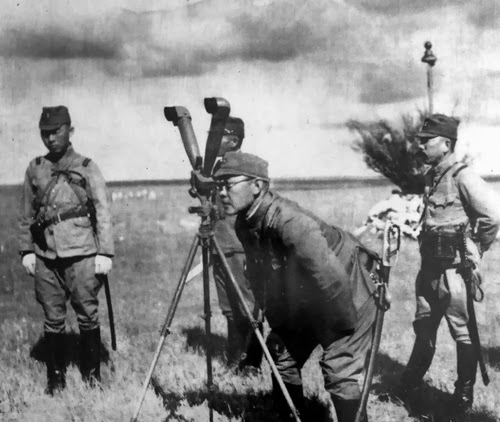
The Battle of Khalkhin Gol, known to the Japanese during the period as the Nomonhan Incident, is one of the most important conflicts of World War II that is often completely ignored or only a minor footnote in most concise or comprehensive popular history and academic studies of World War II. This border conflict fought on the edges between China and Mongolia developed into a major conflict during the Battle of Khalkhin Gol, dating back to previous border clashes during and after the Russian Civil War in the early 20's. The conflict quickly escalated in the spring of 1939 into a "small" conflict with a contained front that became a major theater of war by the time the Red Army claimed victory in September 1939-just as World War II had begun with the invasion of Poland. Japanese Officers observing the Nomonhan Front, 1939 Critical to the later events of World War II itself, Khalkhin Gol was one of the most decisive and important conflicts fought during the last months...