Posts

Franco-Thai War of 1940-1941: Vichy France's Proxy War in Southeastern Asia
Image
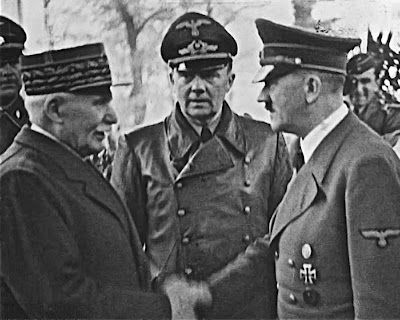
Vichy France's "small war" with Thailand in 1940-1941 is one of the most unique campaigns and micro conflicts in the greater military history of World War Two (1939-1945). Marshall Pétains shakes Adolph Hitler's hand, 1941 The Vichy collaborators in France and abroad formed a coalition/puppet government with their conquerors in the North of France while a 'free' southern zone was established rule by Vichy following the defeat of the French Army and the capture of Paris. The Vichy army fought rather poorly against their former Allies in North Africa while helping to cement fascist rule throughout occupied metropolitan France and Algeria. Thousands of miles away in French Indochina where French rule had been established by imperial conquest beginning in 1862 as French Cochinchina (Vietnam), the Vichy government collaborated nominally with the Japanese in fear of being ousted by the Imperial Japanese Army (IJA) forces who were already poised to invade the region ...

Odd Fighting Units: The Manchurian Stormtroopers, Japan's Skull Squadron, 1929-1933

Image
The Second Sino-Japanese Conflict of 1931-1945 saw thousands of different regiments, divisions, units, and armies, nationalities fighting throughout what is today Mainland China, Myanmar (Burma), Mongolia, and Korea. Torn apart by revolution and civil war from 1911-1930, China faced a great challenge to its national sovereignty when the mighty Japanese military decided to press its economic and political claims in Manchuria and Northern China beginning in 1930-1931. Japanese Army artillery in Manchuria, 1931 One of the most unique Imperial Japanese Army (IJA) units to fight in the earliest portion of the great Sino-Japanese conflict of 1931-1945 was the Skull Regiment, known alternatively as the Skull Squadron and as the “Manchurian Stormtroopers” for their unique regimental iconography and symbols. The Japanese Skull Regiment was seemingly inspired by the German Totenkopf, or Death’s Head regiments/brigades of the 18th-20th centuries.  Formed originally during the reign of King Fr...

Russia's Hawaiian Fortress: The Old Russian Fort on Kauai, 1817-1853

Image
One of the most impressive man-made structures on the beautiful “Garden Island” of Kaua’i County, Hawaii’s most populated, westernmost island, relating to military history and warfare studies is the Russian constructed (1817) Fort Elizabeth. Its walls and defensive structures still stand today, albeit in ruins, outside of Waimea on the southwestern Kaua’i coast on the eastern banks of the Waimea river mouth overlooking Waimea Bay, directly off what is today the Kaumuali'i Highway. These ancient overgrown red volcanic rocks and ruined outer defenses are all that remain of the Russian Empires attempts to colonize and intervene in the Hawaiian Islands ( Mokupuni o Hawai‘i ) from c.1815-1817. Russian Fort Elizabeth, Waimea, Kaua'i  (Taken by the author) To understand the importance of Russian influence and the importance of Kaua’i one must look to the decades of fighting inter-Island warfare which had all but come to end following the unification of the Hawaiian islands, save for...

Imperial Japan's Kwantung Army: China, Manchuria, & Mongolia, 1931-1937

Image
The culture of the Japanese Army and its rigid command structure is critical in analyzing the strategies used by them in China from 1931-1939. The Kwantung Army was an anomaly in the greater study of the Imperial Japanese Army (IJA) from 1900-1945, in that it often took extra-judicial measures in its occupied territories and theatres of operations. Formed in 1919 from the original  Kwantung Garrison , which since 1906 had guarded the southern Manchurian railway from bandits or enemy nations, the Kwantung garrisoned the Liaodong Peninsula. Occupation of this territory had begun during the First Sino-Japanese War of 1894-1895. Japanese Army 'Skull Squadron' Manchuria, 1933 Soon dominated by young officers who privatized and isolated command, the Kwantung often operated under regional command structures. This so called "loyal insubordination" became the key to the Kwantung's military doctrine whilst serving in Manchuria and Northern China beginning in the early 1920...

Red Stick Creek War of 1813-1814 & the Battle of Horseshoe Bend, March 1814

Image
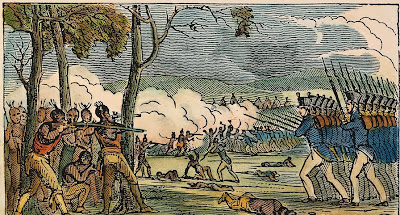
The Second Anglo-American War, more commonly known as the War of 1812, (1812-1815), was fought throughout North America between Great Britain and her Native American Indian allies and the United States of America and its Native American allies. Even though the War of 1812 was predominantly a war between Great Britain and the United States in the context of the greater Napoleonic Wars (1803-1815), it was also one of the first great “Indian Wars” of post-Revolutionary American history. Through a military allegiance with the great Shawnee chief Tecumseh (b.1768-1813) a large struggle between the native peoples of North America (Great Britain’s 1812 Allies) and the young American inhabitants (settlers and military men) who now controlled the territorial destiny of the expanding United States of America began in 1811. By the conclusion of the War of 1812 with the Treaty of Ghent in 1814-1815, US army and state militias had engaged Native American warriors from Canada to Ohio, Tennessee, and...

Battle of the Paper Bridge 1883: The Tonkin Campaign and Black Flag Army of Vietnam

Image
On 19 May 1883, the Battle of the Paper Bridge (Cầu Giấy, Hanoi) was fought between a French column led by Commandant Henri Rivière (b.1827-1883) and the Black Flag Army led by Liu Yongfu (b.1837-1917), a southern Han Chinese bandit, mercenary-soldier, and revolutionary. The Black Flag army ended Rivière’s expedition into the Tonkin (North Vietnam), then a tributary state of the Qing Empire (China and it Imperial provinces, 1644-1912) with a stunning ambush near what was called the Paper Bridge (Pont du Papier) outside modern day Hanoi in Vietnam. Background France’s early campaigns fought in Northern Vietnam from 1881-1889 form just the tail-end of a greater narrative of Franco-Vietnamese and Franco-Sino (Chinese) conflict for control over the Tonkin (Tonquin or Tongkin) province of North Vietnam. The Battle of the Paper Bridge (Cầu Giấy) in 1883 was arguably the first major conflict in France’s commitment to conquer and pacify what became Vietnam and French Indochina (1896-1954). The...