Posts

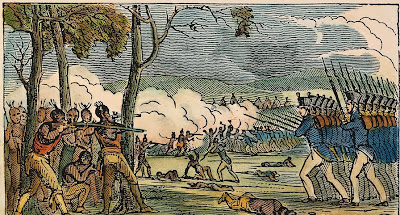
Red Stick Creek War of 1813-1814 & the Battle of Horseshoe Bend, March 1814
Image
The Second Anglo-American War, more commonly known as the War of 1812, (1812-1815), was fought throughout North America between Great Britain and her Native American Indian allies and the United States of America and its Native American allies. Even though the War of 1812 was predominantly a war between Great Britain and the United States in the context of the greater Napoleonic Wars (1803-1815), it was also one of the first great “Indian Wars” of post-Revolutionary American history. Through a military allegiance with the great Shawnee chief Tecumseh (b.1768-1813) a large struggle between the native peoples of North America (Great Britain’s 1812 Allies) and the young American inhabitants (settlers and military men) who now controlled the territorial destiny of the expanding United States of America began in 1811. By the conclusion of the War of 1812 with the Treaty of Ghent in 1814-1815, US army and state militias had engaged Native American warriors from Canada to Ohio, Tennessee, and...

Battle of the Paper Bridge 1883: The Tonkin Campaign and Black Flag Army of Vietnam

Image
On 19 May 1883, the Battle of the Paper Bridge (Cầu Giấy, Hanoi) was fought between a French column led by Commandant Henri Rivière (b.1827-1883) and the Black Flag Army led by Liu Yongfu (b.1837-1917), a southern Han Chinese bandit, mercenary-soldier, and revolutionary. The Black Flag army ended Rivière’s expedition into the Tonkin (North Vietnam), then a tributary state of the Qing Empire (China and it Imperial provinces, 1644-1912) with a stunning ambush near what was called the Paper Bridge (Pont du Papier) outside modern day Hanoi in Vietnam. Background France’s early campaigns fought in Northern Vietnam from 1881-1889 form just the tail-end of a greater narrative of Franco-Vietnamese and Franco-Sino (Chinese) conflict for control over the Tonkin (Tonquin or Tongkin) province of North Vietnam. The Battle of the Paper Bridge (Cầu Giấy) in 1883 was arguably the first major conflict in France’s commitment to conquer and pacify what became Vietnam and French Indochina (1896-1954). The...

Outer Mongolian Revolution: Tibetan-Buddhist Holy Warriors & the Asiatic Cavalry Division, 1919-1922

Image
After the Russian Revolution but before the communist 'Red' Bolsheviks had yet to secure a total victory during the Russian Civil War (1917-1923), Soviet leadership under Lenin, Trotsky, and later Joseph Stalin (b.1878-1953), looked to the Far East to establish a sphere of influence as a buffer to Imperial Japan’s growth in the East and Pacific Ocean following the Russo-Japanese War of 1904-1905. The Japanese Empire spent most of the 1920’s and 1930’s refining and building their military capabilities for their planned economic and cultural domination of Asia which would begin in China and Soviets sensed that the Far East would become a vital diplomatic and military frontier later on.   Hence the early heightening of Soviet political and military presence in Mongolia at the tail end of the Russian Civil War in 1920-1921.  The 'Bloody White Baron of Mongolia': Baron Roman Maximilian von Ungern-Sternberg  After crushing most if not all of the White resistance on the Russia...

Polish-Soviet War 1919-1921: Part II, Battle for Warsaw, Fight for the Zamość Ring, and the Peace of Riga 1921

Image
Part I: Polish-Soviet War, 1919-1920 In early August 1920 the Polish-Soviet conflict had finally arrived at the concluding final months of major combat operations on what the Soviets considered then (and where historians the Western (Polish) Front. Staged to attack and overrun Warsaw the capital of Poland, the Red Army of General Mikhail Tukhachevsky was prepared to conquer Poland with its considerable military might defending the Vistula defenses from north to south. Advancing quickly from Galicia and the South-West Front in the Ukraine in the first week of August the Konarmiya waited to gather strength and for the artillery to be brought up so they could cross the Vistula and take the city for the Proletariat and for comrades Lenin and Trotsky. Polish machinegun crew during the defense of Warsaw August 1920 For the Red Army on the Western (Polish) Front in early August 1920, a massive shift of armies and fronts occurred in which Poles reformed lines while Tukhachevsky ordered his gen...