Posts

Outer Mongolian Revolution: Tibetan-Buddhist Holy Warriors & the Asiatic Cavalry Division, 1919-1922

Image
After the Russian Revolution but before the communist 'Red' Bolsheviks had yet to secure a total victory during the Russian Civil War (1917-1923), Soviet leadership under Lenin, Trotsky, and later Joseph Stalin (b.1878-1953), looked to the Far East to establish a sphere of influence as a buffer to Imperial Japan’s growth in the East and Pacific Ocean following the Russo-Japanese War of 1904-1905. The Japanese Empire spent most of the 1920’s and 1930’s refining and building their military capabilities for their planned economic and cultural domination of Asia which would begin in China and Soviets sensed that the Far East would become a vital diplomatic and military frontier later on.   Hence the early heightening of Soviet political and military presence in Mongolia at the tail end of the Russian Civil War in 1920-1921.  The 'Bloody White Baron of Mongolia': Baron Roman Maximilian von Ungern-Sternberg  After crushing most if not all of the White resistance on the Russia...

Polish-Soviet War 1919-1921: Part II, Battle for Warsaw, Fight for the Zamość Ring, and the Peace of Riga 1921

Image
Part I: Polish-Soviet War, 1919-1920 In early August 1920 the Polish-Soviet conflict had finally arrived at the concluding final months of major combat operations on what the Soviets considered then (and where historians the Western (Polish) Front. Staged to attack and overrun Warsaw the capital of Poland, the Red Army of General Mikhail Tukhachevsky was prepared to conquer Poland with its considerable military might defending the Vistula defenses from north to south. Advancing quickly from Galicia and the South-West Front in the Ukraine in the first week of August the Konarmiya waited to gather strength and for the artillery to be brought up so they could cross the Vistula and take the city for the Proletariat and for comrades Lenin and Trotsky. Polish machinegun crew during the defense of Warsaw August 1920 For the Red Army on the Western (Polish) Front in early August 1920, a massive shift of armies and fronts occurred in which Poles reformed lines while Tukhachevsky ordered his gen...

Polish-Soviet War 1919-1920: Part I, Poland's War in Latvia, Lithuania, & Western Ukraine

Image
Polish-Soviet War, 1919-1921 Part II Arguably one of the most important “Inter-War” conflicts of 1919-1938, the Polish-Soviet War of 1919-1920 was fought between a newly created and independent Polish Republic (1918-1939) and Bolshevik Russia in Poland, in the Baltic and Galicia and Western Ukraine primarily. Polish volunteer cavalry, a so-called 'Death Squadron', 1920 Born out of centuries of state warfare and great territorial and population shifts between long gone kingdoms, empires, and states of the medieval, renaissance, and enlightened eras (see the Partitions of Poland and the Border of 1772), the Polish-Soviet Wars’ origins lay most directly in the defeat of the Imperial German army in the West, November 1918. They had occupied Poland and Warsaw as a major fortified soldiercity on the Eastern Front against Imperial Russia from 1914-1917 during World War I. Polish independence was proclaimed immediately after the Armistice between the Entente and Central Powers and prov...

Battle of Winchelsea 1350: The Great Anglo-Spanish Naval Battle of the Hundred Years’ Wars

Image
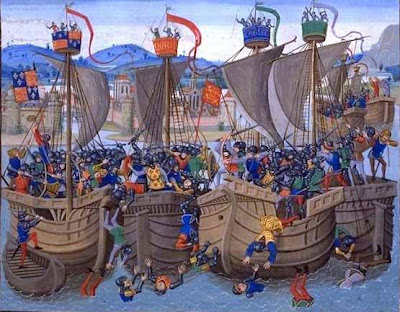
On August 29th of 1350, the Battle of Winchelsea, known also as the Battle of Les Espagnols Sur Mer , was fought off the southern coast England between the fleets of King Edward III of England (b.1312-1377) and the Castilian (Spanish) prince Don Carlos de la Cerda (b.1327-1354). The Channel was and is still today the gateway to south England and during the Hundred Years’ War (1337-1453) it was the site of the oft forgotten Battle of Winchelsea. The Battle of Sluys 1340 as depicted in an illumination from Froissart's Chronicles Battle of Winchelsea in 1450 An aggressive English naval strategy from 1340-1429 during the Hundred Years' Wars often led to the piracy of any and all ships crossing or returning from the Channel into the North Atlantic. A greater English strategy protected both the major channel ports and the western Irish sea ports, the English always wary of any French, Scottish, and/or Spanish vessels looking for easy plunder along the coast just as the Vikings of the...